Kinetic vs Structural Moats Explained
A structural moat lives in the company and compounds on its own (data, network, lock-in, trust); a kinetic moat lives in you and only holds while you keep moving. Most AI-era startups are running on a kinetic moat while believing they've built a structural one.
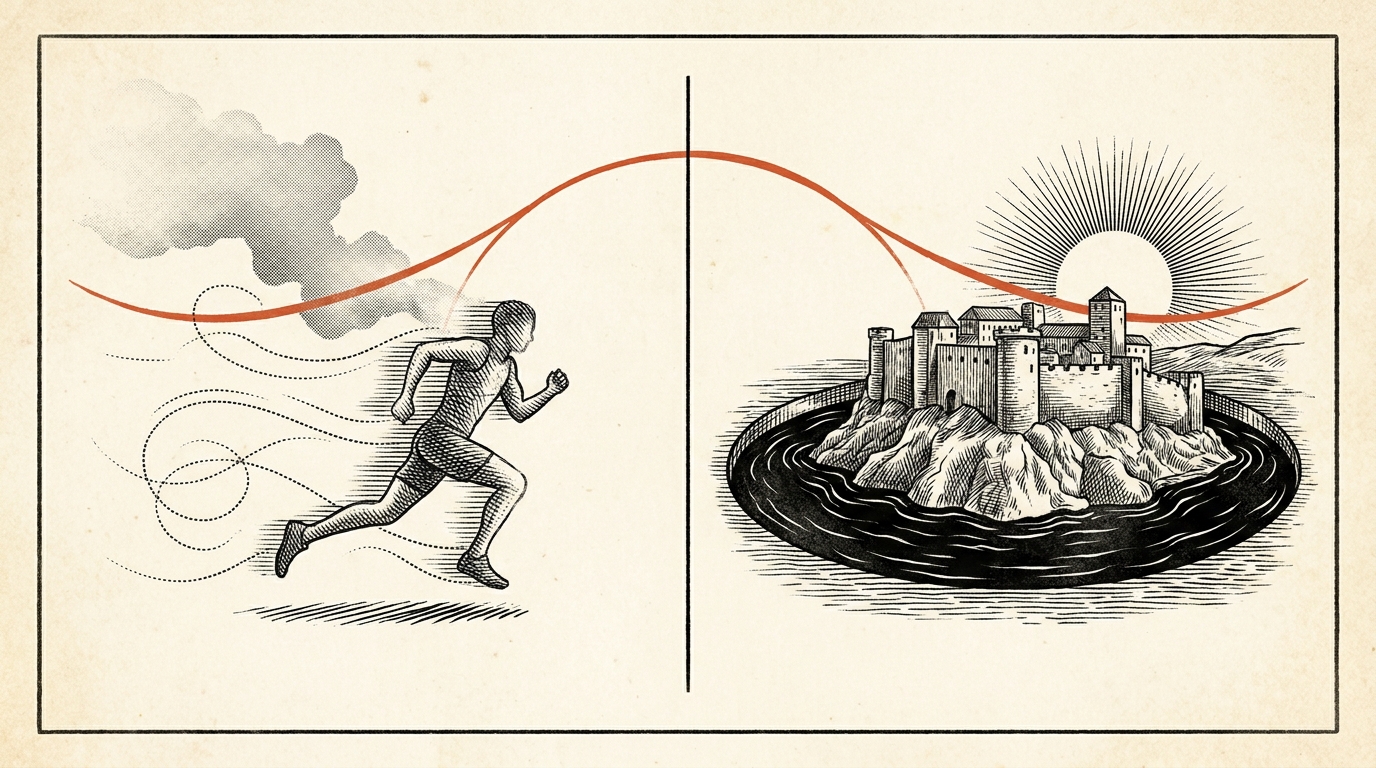
A kinetic vs structural moat is the difference between two kinds of defensibility that look identical on a pitch deck and behave nothing alike in year three. A structural moat lives in the company and keeps working while you sleep, the data that compounds every time a customer uses you, the network you assemble one user at a time, the lock-in nobody rips out without rewiring half their stack, the trust you earn slowly where being wrong is expensive. A kinetic moat lives in you, it's your velocity, you ship faster than anyone can copy and read each new user better than the cloner will, and it holds for exactly as long as you keep moving. Both are real, but only one survives you slowing down, and most of the companies started in the last two years are quietly betting on the wrong one.
The two kinds, and why the difference is the whole game
I sort moats into these buckets before I sort them onto any ladder, because the ladder grades the idea and the buckets grade the odds. The structural ones are the kinds an economist would recognize, switching costs and network effects and scale, and they throw off their advantage on their own. The kinetic kind never shows up in that vocabulary because it isn't in the company at all. It's the founder who out-ships the market out of plain obsession, who owns the room the customers are standing in, who has spent six years inside the exact problem and will out-build any tourist who read about it on a Tuesday. A structural moat is owned. A kinetic moat is rented, and the day you slow down the rent comes due, because there was never anything underneath it but you.
Why the AI era is a trap for this exact mistake
The tools collapsed the cost of building. The codebase and database and interface and integration that used to take a small team a quarter now takes a good builder a weekend with Cursor or Claude Code, and a working product feels like a moat in a way it has no right to. Shipping first and iterating faster is kinetic, a lead that holds only while the legs hold, and if a weekend reproduces your product the code was never your moat, and "mine handles the edge cases" won't save you, because the next person's Claude Code handles them too. a16z put it in a line I keep coming back to, differentiation is not the same as defensibility, and the gap between those two words is where most of these companies are going to die.
You can watch this happen when someone with more resources wants your thing. The Samwer brothers cloned Airbnb's software in a few weeks back in 2011 and shipped it across Europe as Wimdu, funded north of ninety million dollars, and it should have worked on every spreadsheet. What they couldn't clone was the hosts and guests already on Airbnb, and that one structural fact ate the whole effort. The software was kinetic and copyable in a month, but you cannot type a network into existence no matter how much capital you point at it.
Structural versus kinetic, side by side
| Dimension | Structural moat | Kinetic moat |
|---|---|---|
| Where it lives | In the company | In you, the founder or team |
| What feeds it | Customer usage and trust that compound over time | Your speed and undivided attention |
| Works while you sleep | Yes, compounds on its own | No, only while you're moving |
| What kills it | A better network, dataset, or switching cost | You slowing down, burning out, or getting distracted |
| Example | Airbnb's hosts and guests | A solo founder out-shipping a funded clone |
The practical move: use the lead to dig
None of this is an argument against starting kinetic. Almost everyone does, and the studio I run has shipped things that ran on speed alone and slept fine doing it. The mistake is spending the whole lead defending the lead, sprinting to stay a step ahead of a clone that was never going to kill you, when the platform shipping your feature at its next demo day will. So treat the kinetic moat as a loan, and the only question that matters is what you build before it comes due. Pour every week back into the product getting faster and you've just deferred the moment your legs give out. Pour it into a dataset that improves every time a customer touches it, or an integration a customer would have to fire a department to remove, and the kinetic moat did its one useful job, keeping you alive long enough to dig a structural one underneath you.
This is the second axis on the larger framework, the Moat Line: the ladder tells you which rung an idea sits on, and the kinetic-versus-structural read tells you who's holding it and how long they can hold. A weekend clone beats a tourist. It does not beat someone who was always going to outwork it and spent the lead digging.
Common questions
Is a kinetic moat worth anything if it disappears when you stop?
Yes, as long as you treat it as temporary. A kinetic moat buys time, and time is the one input a structural moat can't be built without. Stripe spent its early kinetic edge, a better developer experience and faster shipping, on piling up integrations and trust that are now a real pain to leave, so the thing that started as speed turned into switching costs.
How do I tell which kind of moat I have?
Ask what happens to your lead if you take a month off. If a competitor closes the gap because you stopped moving, the moat was kinetic and your velocity was the whole thing. If the gap holds because customers kept generating data or nobody could justify the switching cost, that part is structural. Most companies have some of both, and the honest exercise is naming which one you're leaning on.
Does hard technology count as a structural moat?
Usually not on its own. Hard tech buys a lead, not a moat, because difficulty is exactly what the tools are collapsing fastest. A technically impressive thing stays kinetic until it starts throwing off data or lock-in or scale a competitor can't catch no matter how fast they move, and until it does, it's a head start with a stopwatch running.
lines worth stealing